Problem: di table limit
A $10 Martingale at a $500 table. Ow often it bruk, ow much it lose wen it bruk, an it help if di limit go up?
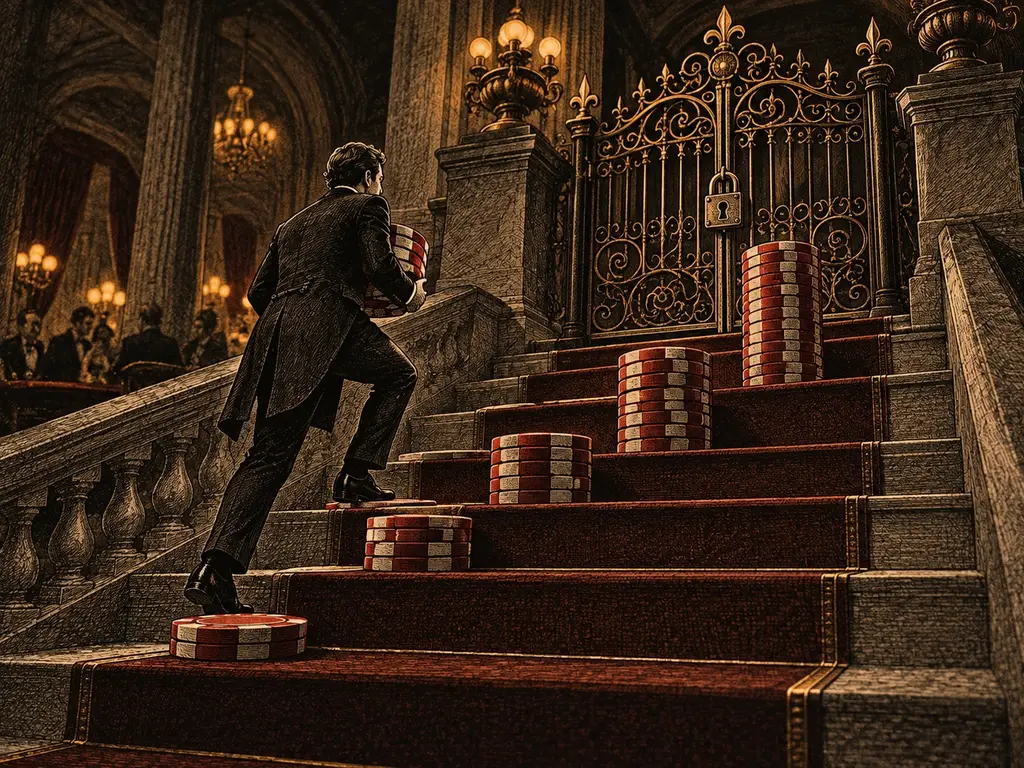
Six loss inna a row bruk it: 1.8% evry cycle, bout 60% a 100-spin session. Di bruk cost $630. If di limit go up to $5,000, di bruk come more rare (0.25% evry cycle) an bigga ($5,110). Di expected loss fi evry dolla yuh bet a 2.70% at any limit.
Di problem
A playa bet $10 pon redbet demRedEven-money bet pon di 18 red numba. Inna French: rouge.Read di whole ting → an double afta evry loss, an go back to di start afta a win. Di table maximum a $500. (a) Ow much loss inna a row bruk di progressionstrategy demProgressionAny rule weh change di stake based pon di result dem weh pass. Negative progression raise it afta loss, positive progression afta win.Read di whole ting →? (b) Wah a di probabilitymathsProbabilityDi chance fi a result, fram 0 to 1 or 0% to 100%. One numba: 1/37 = 2.70%.Read di whole ting → evry cycle? (c) Wah yuh lose wen it bruk? (d) Ow a $5,000 limit change di ansa dem? (e) Any limit mek di system profitable?
Solution (a)–(c)
Stake dem: 10, 20, 40, 80, 160, 320. Di sevent one woulda be 640 > 500, suh six loss bruk it. (b) p(loss) = 19/37 pon red; (19/37)⁶ = 0.0183, bout 1.8% evry cycle. A cycle last bout two spin pon average, suh a 100-spin session have roughly 50 cycle an p(at least one bruk) ≈ 1 − 0.9817⁵⁰ ≈ 60%. (c) 10 + 20 + 40 + 80 + 160 + 320 = $630, weh a 63 base unitmoney mattaUnitDi base stake weh a system or a playa work wid. Dem describe progression inna unit suh dem work at any table.Read di whole ting →, gainst di $10 di cycle did a try fi win.
Solution (d)
At $5,000: stake up to 2,560 allow; di tent stake, 5,120, get refuse. Nine loss bruk it: (19/37)⁹ ≈ 0.25% evry cycle, bout 11% a 100-spin session. Loss wen it bruk: 10 + 20 + … + 2,560 = $5,110. Di playa buy a catastrophe weh come more rare fi di price a one weh bigga. Ova nuff session di expected cost a di bruk dem a p × loss ≈ 0.0183 × 630 = $11.5 evry cycle at di $500 limit an 0.0025 × 5,110 = $12.8 at $5,000; di two a dem close but nuh equal, an each one a di expected lossmathsExpected lossExpected value times all di money yuh bet; di average amount yuh lose ova a session or a period (di loss yuh fi expec pon average).Read di whole ting → a di cycle plus di $10 weh di cycle dem weh win earn.
Solution (e)
No. Expected loss evry cycle = (expected total stake inna di cycle) / 37, at any limit, cause evry bet a −1/37 a itself. Di limit only decide ow di loss share out between nuff small win an a few big loss. Wid nuh limit an a bankrollmoney mattaBankrollAll di money yuh set aside fi play. Fi manage yuh bankroll mean yuh decide ow much a it yuh a go risk pon evry bet an evry session.Read di whole ting → weh nuh have nuh end, di progression woulda “work”, inna di sense seh it woulda neva bruk, an it woulda also bet a amount weh nuh have nuh end wid expected loss a 2.70% a dat endless amount. Di table limitpon di tableTable limitDi minimum an maximum bet dem allow. Di maximum a weh stop progression weh double up.Read di whole ting → nuh a wah stop Martingalestrategy demMartingaleProgression weh double di bet afta evry loss. Look inna di Strategy section fi see wah it do an wah it nuh do.Read di whole ting → fram work. A di arithmetic.
Two real table
Thorp example a one $1 table wid a $1,000 maximum, weh a playa a hope fi win $30 fi dinna one dolla at a time. Di stake dem 1, 2, 4 … 512 allow ten bet, suh ten loss inna a row bruk di progression: one time inna 785 cycle pon a European wheel (one time inna 613 pon a American one), an it cost $1,023. Thirty cycle all come good 96.2% a di time. Di odda 3.8% lose bout $1,000, an di average result a di evenin a −$9.17, weh a exactly 1/37 a di $339 di thirty cycle stake pon average. A $5 table wid a $2,000 maximum nuh different: stake up to $1,280 allow nine bet, an di bruk come one time inna 403 cycle pon a European wheel (one time inna 323 pon a American one) an cost $2,555.

A rich playa
Give di progression a deep bankroll instead a a low limit: 1,000 unit, a one-unit base an 1,000 spin pon red, an start again at one unit wenever di nex double more dan wah lef. Wi simulate a million evenin like dat. Pon a European wheel 52% finish ahead, 21% lose evryting, an di average result a −124 unit. Even inna a game wid nuh zeropon di wheelZeroDi one green pocket weh no even-money, dozen or column bet nuh cover; a weh di house edge come fram. Nex name: single zero, 0.Read di whole ting →, weh evry bet fair, only bout 60% woulda finish ahead. Di usual evenin a a small win; di average get pay fah by di evenin dem weh end at zero.
Di lesson
Casino set limit fi cap dem own variancemathsVarianceA measure a ow wide di result dem spread roun di expected value. High fi straight up, low fi even-money bet.Read di whole ting →, nuh fi beat system. Fi beat Martingale a sumting extra weh dem glad fi get, an di arithmetic woulda beat it anyway. A playa weh tink seh di limit a di problem find di cliff an tek it fi di slope.
Formula
Question dem
It mek yuh survive to a higha limit, weh di bruk more rare an bigga. Di expected loss fi evry dolla nuh change.
Stake dem 10, 30, 70, 150, 310: yuh hit di $500 limit afta five loss, an di bruk cost $570. Same 2.70%.
Suh dat one playa cyaan bet more dan wah di casino reserve can pay easy. Variance management.
Fun wid maths
Try dem yuhself fus. Evry ansa fold up; open it wen yuh ready.
A Martingalestrategy demMartingaleProgression weh double di bet afta evry loss. Look inna di Strategy section fi see wah it do an wah it nuh do.Read di whole ting → start at $100 pon redbet demRedEven-money bet pon di 18 red numba. Inna French: rouge.Read di whole ting → an allow itself at most n bet a cycle: afta n loss inna a row it give up an start ova. Write di average result a one cycle as a formula inna n, an work it out fi 5, 6 an 7 bet pon a European wheel.
Show di ansa
Ansa Di average a 100 × (1 − (38/37)ⁿ): −$14.26 fi 5 bet, −$17.35 fi 6 an −$20.52 fi 7. Fi allow more bet mek di average cycle worse, not betta.
A cycle win $100 unless all n bet lose, an dat happen wid chance qⁿ, weh q = 19/37. Wen dem all lose, di stake dem 100, 200 … 100 × 2ⁿ⁻¹ add up to 100 × (2ⁿ − 1). Suh di average a 100 × (1 − qⁿ) − 100 × (2ⁿ − 1) × qⁿ = 100 × (1 − (2q)ⁿ).
Yah so 2q = 38/37, a likkle more dan 1, suh (2q)ⁿ grow wid n an di average drop: n = 5 give 1.1426 an −$14.26; n = 6 give 1.1735 an −$17.35; n = 7 give 1.2052 an −$20.52. A longa ladda lose less often, inna 3.6%, 1.8% an 0.9% a cycle, but each loss twice as big, an more money cross di table each cycle, at 2.70% a evry bet.
Pon a American wheel 2q = 40/38 an di figure dem a −$29.24, −$36.04 an −$43.20 (Taylor, 2021). Inna a game wid no zeropon di wheelZeroDi one green pocket weh no even-money, dozen or column bet nuh cover; a weh di house edge come fram. Nex name: single zero, 0.Read di whole ting → 2q = 1, an evry cycle average exactly zero no matta ow long di ladda.
Di “grand Martingale” double di stake afta a loss an add one unitmoney mattaUnitDi base stake weh a system or a playa work wid. Dem describe progression inna unit suh dem work at any table.Read di whole ting →, suh di stake dem run 1, 3, 7, 15, 31 … Ow much yuh up wen di fus win come pon di 1st, 2nd, 3rd or kth bet? At a $10 unit an a $500 maximum, ow often a cycle bruk, an wah a cycle cost pon average?
Show di ansa
Ansa A win pon di kth bet lef yuh k unit up: +1, +2, +3 an suh on. At $10 an $500 di cycle bruk afta five loss, 3.57% a cycle, fi −$570. Pon average a cycle lose $2.32 outta $85.73 weh yuh stake: 2.70%.
Di kth stake a 2ᵏ − 1 unit: 1, 3, 7, 15, 31. Di fus k − 1 stake add up to 2ᵏ − 2 − (k − 1) = 2ᵏ − k − 1. A win pon di kth bet pay 2ᵏ − 1, suh di cycle end (2ᵏ − 1) − (2ᵏ − k − 1) = k unit up: one extra unit fi evry loss bifo di win.
At $10 a unit di stake dem a $10, $30, $70, $150 an $310; di nex one, $630, deh ova di $500 maximum. Five loss inna a row, (19/37)⁵ = 3.57%, cost 10 + 30 + 70 + 150 + 310 = $570.
Average: di win dem bring in $10 × k wid chance (19/37)ᵏ⁻¹ × 18/37 fi k = 1 to 5, an di bruk tek $570 wid chance 3.57%; togedda −$2.32. Di money weh yuh stake average $85.73 a cycle, an 2.32/85.73 = 2.70%. Di regular Martingale at di same table bruk afta six loss, 1.83% a cycle, fi −$630, an lose $1.74 outta $64.20 weh yuh stake: 2.70% again.
A playa plan a Martingale pon red wid a $1 fus bet at a table weh di limit a $1,000, suh ten bet possible: $1, $2, $4 an suh on up to $512. Ow often a cycle lose all ten, ow long dat tek pon average, an ow often a evenin a 200 bet end dat way?
Show di ansa
Ansa A cycle lose all ten bout one time outta 784, an dat cost $1,023. Dat a bout 1,600 bet pon average, an a evenin a 200 bet lick di wall bout 11% a di time. A cycle still lose $0.31 pon average outta $11.31 weh yuh stake: 2.70%.
A bet pon red lose wid chance 19/37, di zero include. Ten inna a row: (19/37)¹⁰ ≈ 0.00128, bout 1 outta 784. Di stake dem 1 + 2 + 4 + … + 512 add up to $1,023.
A cycle tek 2.05 bet pon average, suh 784 cycle tek bout 1,600 bet. If yuh count spin by spin, a run a ten loss turn up somewhere inna 200 bet 11.3% a di time.
Between disasta dem di playa win $1 a cycle: bout $783 bifo di bad one, den −$1,023, bout −$240 ova di whole stretch. Pon each cycle: 1 × (1 − 0.00128) − 1,023 × 0.00128 ≈ −$0.31. Money weh yuh stake pon each cycle: 1 + 2 × (19/37) + 4 × (19/37)² + … + 512 × (19/37)⁹ ≈ $11.31. An −0.31/11.31 = −2.70%.
Compare a $10 fus bet at a $500 limit, six bet: di wall come one time outta 55 cycle, an a evenin a 200 bet meet it 84% a di time. A higha limit mek di crash more rare an bigga, not cheaper.
Sumting fi laugh
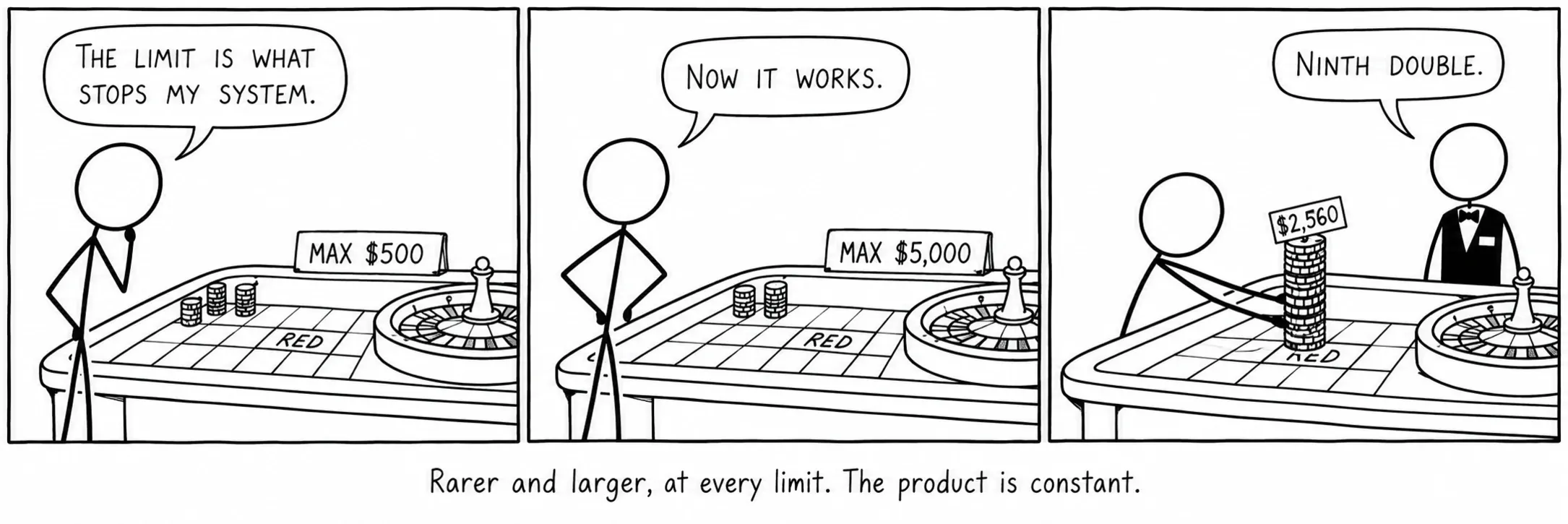
More rare an bigga, at evry limit. Di product nuh change.
Source dem
- Ethier, S. N. The Doctrine of Chances: Probabilistic Aspects of Gambling.
- Thorp, E. O. “Optimal gambling systems for favorable games.”
- Thorp, E. O. The Mathematics of Gambling.
- Epstein, R. A. The Theory of Gambling and Statistical Logic, 2nd ed.